So the essence of grimdark is that everyone’s inherently sort of a bad person and does bad things, and that’s awful and disheartening and cynical. It’s looking at human nature and going, “The glass is half empty.”
Hopepunk says, “No, I don’t accept that. Go fuck yourself: The glass is half-full.” YEAH, we’re all a messy mix of good and bad, flaws and virtues. We’ve all been mean and petty and cruel, but (and here’s the important part) we’ve also been soft and forgiving and KIND. Hopepunk says that kindness and softness doesn’t equal weakness, and that in this world of brutal cynicism and nihilism, being kind is a political act. An act of rebellion.
Hopepunk says that genuinely and sincerely caring about something, anything, requires bravery and strength. Hopepunk isn’t ever about submission or acceptance: It’s about standing up and fighting for what you believe in. It’s about standing up for other people. It’s about DEMANDING a better, kinder world, and truly believing that we can get there if we care about each other as hard as we possibly can, with every drop of power in our little hearts.
Going to political protests is hopepunk. Calling your senators is hopepunk. But crying is also hopepunk, because crying means you still have feelings, and feelings are how you know you’re alive. The 1% doesn’t want you to have feelings, they just want you to feel resigned. Feeling resigned is not hopepunk.
Examples! THE HANDMAID’S TALE is arguably hopepunk. It’s scary and dark, and at first glance it looks like grimdark because it’s a dystopia… but goddammit she keeps fighting. That’s the key, right there. She fights every single day, because she won’t let them take away meaning from her life. She survives stubbornly in the hope that one day she can live again. “Don’t let the bastards grind you down,” is one of the core tenets of hopepunk, along with, “The arc of the moral universe is long, but it bends towards justice.”
Jesus and Gandhi and Martin Luther King and Robin Hood and John Lennon were hopepunk. (Remember: Hopepunk isn’t about moral perfection. It’s not about being as pure and innocent as the new-fallen snow. You get grubby when you fight. You make mistakes. You’re sometimes a little bit of an asshole. Maybe you’re as much as 50% an asshole. But the glass is half full, not half empty. You get up, and you keep fighting, and caring, and trying to make the world a little better for the people around you. You get to make mistakes. It’s a process. You get to ask for and earn forgiveness. And you love, and love, and love.)
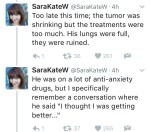
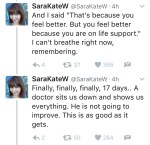
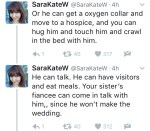
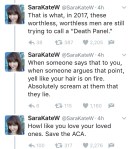
And THIS, this is hopepunk:
Here I am with more addendums to this post: Seems like a lot of people are saying the word “noblebright” at me, and I just want to be really clear about this: Noblebright is not hopepunk. Noblebright does not espouse the same ideals that hopepunk does. They are two distinct, separate, coexisting things.
Noblebright is Arthurian legends. The world is a good place, people are essentially good. The codes of chivalry are in full effect. People in positions of authority are there because they are wise, prudent, caring leaders. They rule because they deserve to rule. They protect the weak, they uphold their ideals, there’s people practicing chaste courtly love in every bower and garden. Things are fine, and people have adventures in which they triumph because (see: all of the above).
Hopepunk is (as many wonderful people in the comments have pointed out) Discworld: The world is the world. It’s really good sometimes and it’s really bad sometimes, and it’s sort of humdrum a lot of the time. People are petty and mean and, y’know, PEOPLE. There are things that need to be fixed, and battles to be fought, and people to be protected, and we’ve gotta do all those things ourselves because we can’t sit around waiting for some knight in shining armor to ride past and deal with it for us. We’re just ordinary people trying to do our best because we give a shit about the world. Why? Because we’re some of the assholes that live there.
Examples of hopepunk media include:
Guardians of the Galaxy: “Why do I want to save the galaxy? Because I’m one of the idiots who lives there?”
Thor Ragnarok: “Asgard is not a place… It is a people.”
Leverage: “Right now, you’re suffering under an enormous weight. We provide… leverage.”
The Librarians: (“I have seen you all die so many times when it didn’t matter, I can’t let it happen now that it does.” “What do you need us to do?”)
Scorpion.: (”If you try to tell me about the greater good one more time, I will hit you.”)
Star Wars: (”There is good in him still.”)
Star Trek (the original universe): (honestly, there’s no one single quote, but like, the entire damn thing is solid hopepunk.)
Wonder Woman: (”It is not about deserve, it is about what you believe.” also “Who will sing for us, Charlie?”)
Also, Mad Max: Fury Road. Angharad is a hopepunk queen, and Furiosa and Max get pushed and pulled on to that path by the end of the movie through their connection to each other and the people they fight with.
More HopePunk quotes, cause I think we all need them:
It’s difficult in times like these: ideals, dreams, and cherished hopes
rise within us, only to be crushed by grim reality. It’s a wonder I
haven’t abandoned my ideals; they seem so absurd and impractical. Yet I cling to them because I still believe, in spite of everything, that people are truly good at heart.— The Diary of Anne Frank
If a hiker gets lost in the mountains, people will coordinate a search.
If a train crashes, people will line up to give blood. If an earthquake
levels a city, people all over the world will send emergency supplies.
This is so fundamentally human that it’s found in every culture without
exception. Yes, there are assholes who just don’t care, but they’re
massively outnumbered by the people who do. And because of that, I had
billions of people on my side. Pretty cool, eh?— Andy Weir, The Martian
No one is born hating another person because of the colour of his skin,
or his background, or his religion. People must learn to hate, and if
they can learn to hate, they can be taught to love, for love comes more naturally to the human heart than its opposite.— Nelson Mandela, Long Walk to Freedom
When I was a boy and I would see scary things in the news, my mother
would say to me, “Look for the helpers. You will always find people who
are helping.”— Fred Rogers
I believe in my fellow citizens. Our headlines are splashed with crime
yet for every criminal there are ten thousand honest, decent, kindly
men. If it were not so, no child would live to grow up. Business could
not go on from day to day. Decency is not news. It is buried in the
obituaries, but it is a force stronger than crime. I believe in the
patient gallantry of nurses and the tedious sacrifices of teachers. I
believe in the unseen and unending fight against desperate odds that
goes on quietly in almost every home in the land.— Robert A. Heinlein
Sure, humans kill each other. We kill for passion, madness, rage, love,
war, and lord knows other things. And yet, we’ve got six billion people
running around the planet. Almost as if people who kill other people are
the exception rather than the rule.— Linkara, Atop the Fourth Wall Marville #4 review
“But we were born of risen apes, not fallen angels, and the apes were armed killers besides. And so what shall we wonder at? Our murders and massacres and missiles, and our irreconcilable regiments? Or our treaties whatever they may be worth; our symphonies however seldom they may be played; our peaceful acres, however frequently they may be converted into battlefields; our dreams however rarely they may be accomplished. The miracle of man is not how far he has sunk but how magnificently he has risen. We are known among the stars by our poems, not our corpses.” – Robert Ardrey
hypothesis: the salt & pepper diner experiment can no longer be conducted as it stands, because everyone is now fully attuned to the opening bars of tom jones’ “what’s new pussycat?”, classically conditioned into a fight-or-flight response. however, this experience can be replicated using 21 back-to-back plays of lou bega’s 1999 hit song “mambo no. 5″, as the general response to “mambo no. 5″ being played twice in a row is not, “hey someone’s playing “mambo no. 5″ again,” but rather, “hey, lou bega’s 1999 hit song “mambo no. 5″ is a lot longer than i first thought.”
So what’s the “It’s Not Unusual” in this situation
Livin’ la Vida Loca
while i love and support this, the intro to m#5 is a pause followed by “ladies and gentlemen this is mambo no 5” before the music starts, which would ruin the intended effect here what would really set this off is Hollaback Girl cause it’s fucking terrible and loops far too well
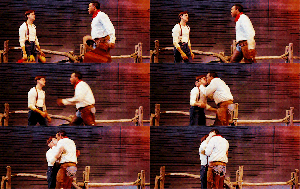
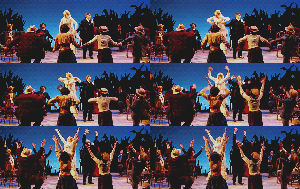
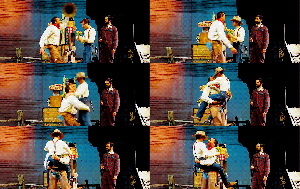
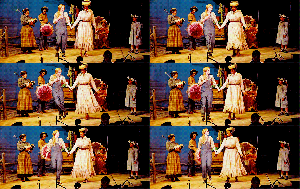
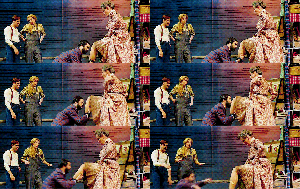
For the 75th anniversary production of Rodgers and Hammerstein’s Oklahoma!, she loves her and he loves him!
Rodgers and Hammerstein’s musical Oklahoma! was revived by the Oregon Shakespeare Festival with LGBT+ Casting. “This revival made the musical’s primary romantic couple, Laurey and Curly, lesbians. It made the comic sidekick couple, Will Parker and Ado Annie, gay men (with “Annie” renamed “Andy”). It’s not just the two romantic couples in the show who have been reimagined. Laurey’s starchy yet sometimes playful Aunt Eller will be a transgender woman (portrayed by a transgender female performer). Ali Hakim will be a bisexual man who has a great fling with Ado Andy, but winds up married to a young bi woman named Gertie Cummings (who also fell in love with Curly). The director, Bill Rauch, felt Jud needed to stay a troubled straight man who, with no changes to the book, is angry that Laurey prefers a woman instead of him. “We wanted also to make sure that the world was not just LGBTQ-inclusive, but that it was clear that this was a community that was thriving, because there are straight allies. They are choosing in this small rural corner of Oklahoma to make a community that is inclusive and that is loving.””
Major changes to a show must be approved by the copyright holder. "Ted Chapin protects the catalog of Rodgers and Hammerstein with great ferocity, and at the same time, he understands the way great classics remain relevant is through thoughtful expansion and reinvention and experiment. So, I was really, really honored — not only to get the permission in general, but the fact that this is the 75th anniversary of ‘Oklahoma!‘
The story of the Tony and Pulitzer Prize winning Oklahoma! centers around Laurey and Curly, who are in love but are too stubborn to admit it to one another. A troubled farmhand, Jud, will do everything in his power to make Laurey fall in love with him instead. "I think this casting really excels in the love song ‘People Will Say We’re In Love,’ a beautiful love song that Laurey and Curly share, but their fear that people will say we’re in love takes on a completely different resonance and a completely different depth when it’s sung by two women, and the courage that it takes for these two people then, you know, finally when they sing, ‘Let people say we’re in love.’ The audience just cries and cheers, because it’s an affirmation in a completely different way.
are you a hair up or hair down kinda person? horror movie or a rom-com? do you like coffee or tea? are you moon or sun? park or coffee shop? romantic love or platonic love?










 Max Armenta's Archive