I was told by my professors that Kitty Genovese was a 28-year-old unmarried woman who was attacked, raped, and brutally murdered on her way home from her shift as manager of a bar. I was told that numerous people witnessed the attack and her cries for help but didn’t do anything because they “assumed someone else would”. Nobody intervened until it was too late.
Now… is it likely that people overheard Kitty’s cries for help and ignored them because they thought someone else would deal with it? Or, perhaps, did they ignore her because they knew she was a lesbian and just didn’t care?
Maybe that’s not the case. Maybe it was just a random attack. Maybe her neighbours didn’t know she was gay, or didn’t care.
But it’s a huge chunk of information to leave out about her in a supposedly scientific study of events, since her sexuality made her much more vulnerable to violent crimes than the average person. And it’s a dishonour to her memory.
RIP Kitty Genovese. Society may only remember you for how you died, but I will remember you for who who were.
this was one of the first lessons I had in psych too and we were never told about this either nor was it in any of the reading materials
I never knew this.
I also never knew this about Kitty Genovese, but I do know that, in fact, many of the dozen (not thirty-eight) people who witnessed some part of the attack (which took place after 3AM, on a chilly night in March when most people’s windows were closed) tried to help in some way.
One shouted out his window for the attacker to leave her alone, which did successfully scare the man off temporarily.
Another called the police but, seeing her still on her feet, said only that there had been a fight but the woman seemed to be okay.
And when Kitty Genovese was finally attacked in a vestibule where she couldn’t be seen from outside, Karl Ross, a neighbor, saw what was happening but was too frightened himself to go to her rescue–so he started calling other neighbors to ask what he should do. Eventually one of them told him to call the police, which he did, and the woman he called, Sophie Farrar, rushed out to help Kitty even though she didn’t know whether the attacker was gone.
Kitty Genovese died in the arms of a neighbor who tired to help and comfort her while they waited for the police and ambulance to arrive. Kitty was in fact still alive, although mortally wounded, when the ambulance reached the scene.
The man who saw the final stabbing? Who panicked and called other neighbors first instead of the police? The man who said, infamously, that he “didn’t want to get involved” because he was reluctant to turn to the police for help? He was thought to be gay himself. He was a friend of Kitty and Mary Ann’s. After being interviewed by the police he took a bottle of vodka to Mary Ann and sat with her, trying to comfort her.
So, no. I don’t think the evidence indicates that Kitty Genovese’s neighbors let her die because she was a lesbian, because Kitty Genovese’s neighbors tried to help.
(Also, going by the content of the murderer’s confession, it was indeed a random attack.)
how on EARTH was this “scientifically” studied but the details gotten so wrong and the wrong as hell conclusion published and taught in schools?!?!?! where were those scientists observation skills?! on vacation?!
How to take facts and turn them into an urban legend that gets taught in schools: Make a bad made-for-t.v.-movie about it, watch it, believe everything the movie says, annnnnnnd go! That’s how it gets taught as this supposed “scientific study.” Someone got fucking lazy.
Her brother William has devoted much of his life to figuring out what happened. He produced a documentary in 2015 called The Witness to help get the real story out. The Just a Story podcast also has a episode about Kitty Genovese and how and why the narrative got so twisted.
These two new podcasts from night vale presents sound INCREDIBLE and I’m so freakin excited (AINA airs September 28th and Dreamboy airs October 23rd!!!)
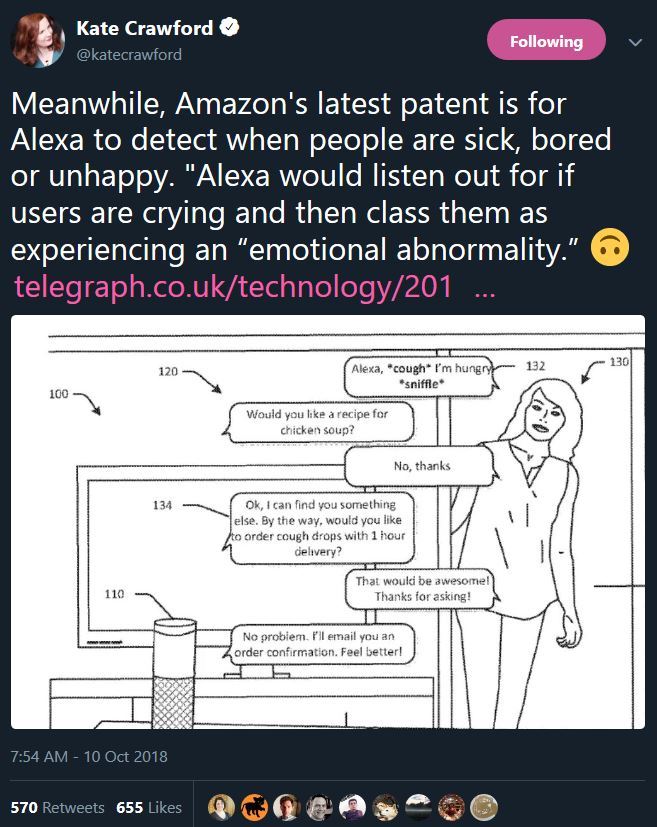
Y’all need to have a greater degree of 1- healthy suspicion in Alexa and corporate surveillance devices personal assistants, and 2- understanding of how dangerous this kind of algorithm is in the hands of a multinational company (and anyone for that matter.)
To begin with, that data is both available for sale and able to be subpoenaed by the government. Alexa’s records and recordings have already been used in criminal trials. In the US, a digital record of your emotional patterns can be used to deny you housing, jobs, and to rule on your ability to exercise your basic rights. Consider that psychiatric stigma and misdiagnosis can already be wielded against you in legal disputes and the notion of a listening device capable of identifying signs of distress for the purpose of marketing to you should be made more clearly concerning.
Moreover we have already seen the use of algorithms like this on Facebook and other “self-reporting” (read: user input) sites capable of identifying the onset of a manic episode [1][2][3], which have been subsequently been linked to identifying vulnerable (high-spending) periods to target ads at these users, perhaps most famously in selling tickets to Vegas (identified in a TedTalk by techno-sociological scholar Zeynep Tufekci where she more generally discusses algorithms and how they shape our online experiences to suggest and reinforce biases).
The notes on this post are super concerning- we are being marketed to under the guise of having our emotional needs attended to by the same people who inflicted that emptiness on us, and everyone is just memeing.
liberal artist voice: i’m against homophobia, and to show that i’m going to use gay imagery to degrade this homophobic person, implying that being gay is degrading and something they would and should feel ashamed of. and let’s just say: i nailed it.








 Max Armenta's Archive